 |
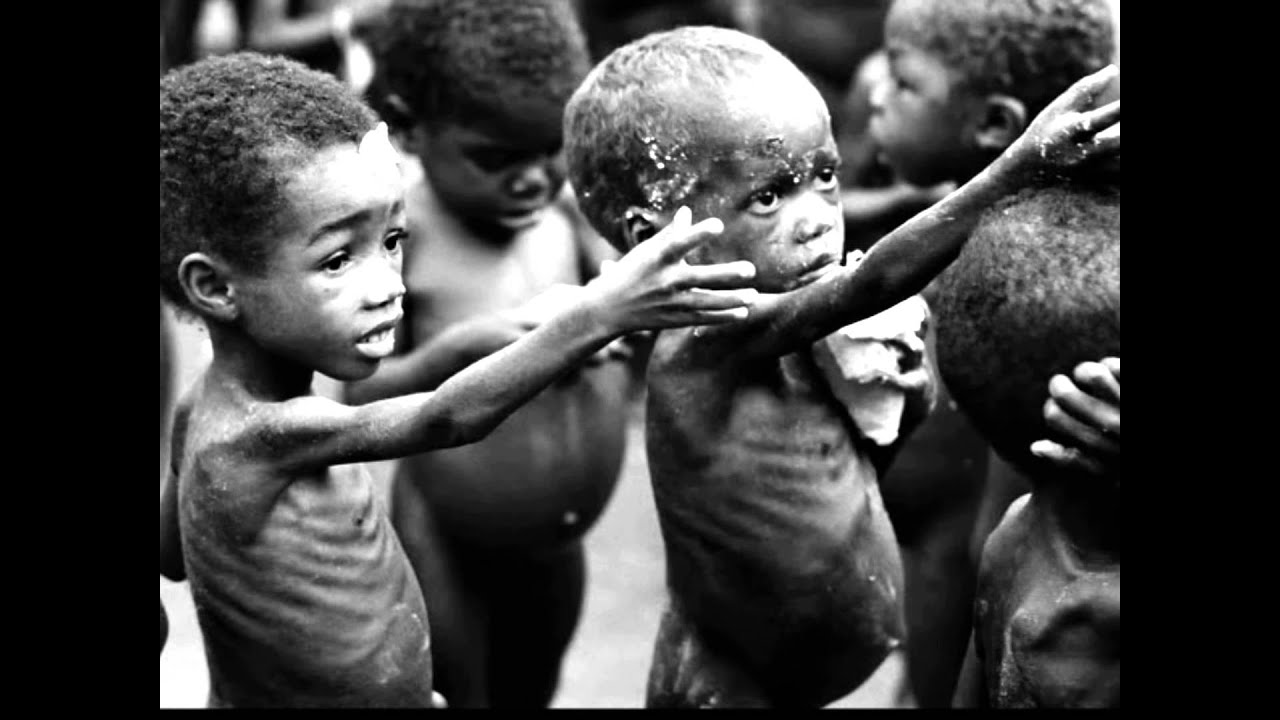
| Figure 1. The Ethiopian famine of 1983-85 (source) |
Over the upcoming weeks, there will be no escape
from the successful Christmas hit written by Bob Geldof and Midge Ure back in 1984 “Do They Know It’s Christmas?”, a song which was written
for the Live Aid concert as an urgent response to the widespread Ethiopian famine (figure 1). The famine was driven by a decade of serve drought and civil war which
claimed 400,000 deaths in Ethiopia alone, spreading across east Africa
and north into the Sahel region. Figures by the UN estimate a total of
over one million deaths during the 1983-85 droughts. Over 50 million people in the Sahel region were estimated to be affected form the period between 1960-1980 - a period characterised by an increase in the frequency of droughts and famine
on a massive scale effecting. This period saw a dramatic shrinking of Lake Chad to 95% of its original size between 1963-1998 effected
over 20 million people in four countries who were highly dependent on the lake
as their main source of water. More recently, drought-induced famine hit the region again in
2010 and 2012 resulting in widespread food and water insecurity, increase in
deaths, illnesses and malnutrition, and economic and political instability. This
blog will explore the role of climate change in driving these drought events.
Rains reach the Sahel during the West African Monsoon summer season with the majority of this highly erratic rain
falling between July-September. Rains are also driven by tropical convection and
the formation of towering thunderstorms, and El Nino events during the abnormal
warming of the Pacific Ocean. Research by the Joint Institute for the Study of
the Atmosphere and Ocean (JISAO) at the University of Washington
suggests that the Sahel region has been in a period of unusually dry years
since the 1960’s as a deficiency in rain, indicated by downward bars in the graph below (figure 2), has occurred for most years since the
late 1960. As the graph shows, the most severe drought was that of the 1980’s,
corresponding with the Ethiopian famine of 1983. Many factors have been proposed
to explain the recent drought period yet the cause of the droughts is still an ongoing debate.
 |
| Figure 2. Sahel precipitation anomalies 1900-2011 (source) |
In the 1970’s, the Sahelian farmers were blamed for the caused of the widespread drought and famine. Environmental problems including overgrazing, deforestation,
over-using natural resources and poor land managements as a result of incorrect
agricultural practices by the Sahel farmers was believed to be the main driver. As suggested by Taylor et al., (2002), the expansion of farmers to marginal areas due to over
population and an increase in food and water demand was believed to cause a reduction in vegetation
coverage which inevitably led to less rainfall. However, recent studies
disprove this idea and the extent at which these environmental factors
could trigger a widespread, multidecadal drought has been questioned as explored by Mantell (2003).
More recently, evidence is accumulating in favour of
climatic triggers. Kerr (2003)
proposes that the warming of the Indian Ocean, which has been shown to dramatically increase
the land temperature across Africa with temperatures reaching 3.5*C in Niger, could have occurred during the 1960-1980 drought period resulting
in water shortages and harsher regional weather . At
the end of 1900’s, rapid warming of surface ocean temperatures may have reduced
the difference between temperatures on land and sea, causing a weakening of the
monsoon. Zhang and Delworth (2006) proposed
another possible natural climatic driver and that the Atlantic Multidecadal Oscillation entered a warming phase which peaked in 1950 and influenced the
atmosphere the following decades.
 |
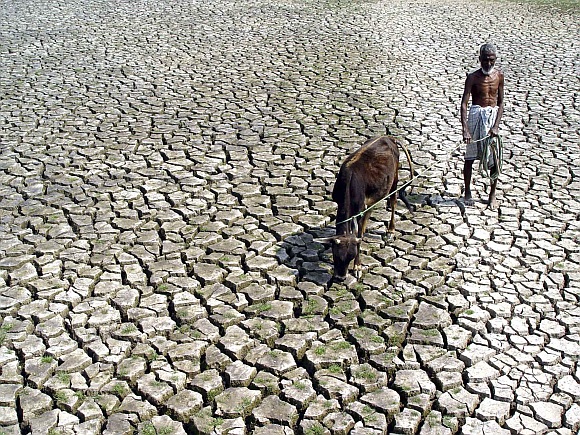
| Figure 3: Extreme drought which hit Africa between 1960-1980 (source) |
Ackerley et al., (2011) proposes that anthropogenically-induced climate change
factors have also been a key driver. Global dimming and the widespread air pollution and aerosols can cause a change in the properties of clouds over the
Atlantic Ocean and the blocking of incoming solar radiation, and this has been suggested to have disturbed the monsoons and shift the tropical rains southwards and away from
the Sahel region. Ackerley et al., (2011) stats that historic aerosols level were modeled and seen to be a key driver behind the 1960-1980 drought. Contradicting this study, Haarsma et al., (2005)
states that the recent global warming as a result of the increasing greenhouse gas
concentrations in the atmosphere, did not play a part in driving the drought, and is more likely to cause an increase in rainfall in the Sahel
region in the future, and this has already been observed since 1980’s by Wang and Gilles (2011). This will be explore in future blogs.
Once again, we see the complexity of
understanding and pin-pointing the main drivers behind extreme climatic events such as the drought period which hit north and east Africa between 1960-1980.
Natural multidecadal climatic variability driven by the change in the sea surface temperature of the Indian Ocean and Atlantic Multidecadal Oscillation may have initially triggered the droughts, but environmental
and social factors including poor-agricultural practices and overpopulation enhanced
the climatic effects resulting in widespread droughts which led to substantial social instabilities, deaths and conflict.